$8 a gallon gas? Possible, unthinkable, awful to consider
Jeff Currie could pass as a preacher. But you may not like what he's preaching.
The partner of the Carlyle Group and head of its Energy Pathways Group thinks oil prices have not yet peaked thanks to the Iran war, now finishing its fourth week. Not even close. Absent a sudden truce, he sees prices rising into the summer before peaking.
How high? Currie has been careful not to put a dollar number on the issues. Wood MacKenzie, a London financial house that specializes in energy, thinks a drawn-out war could push oil prices to $200 a barrel, maybe more.
Related: Iran's shocking threat to boost oil to $200
How does that translate into pump prices in the United States? The U.S. average price was $3.983 a gallon on March 26, according to GasBuddy.com with light sweet crude, the U.S. benchmark at $94.48 per 42-gallon barrel. So, $200 crude would push the U.S. average pump price to darn near $8.
For many folks, $8 for the country means catastrophe. There is one gas station near Dodger Stadium in Los Angeles charging about $8.70 a gallon. California's statewide average is about $5.82 a gallon, according to GasBuddy.com. And Mono County in far-eastern California averages $6.58. The state average in Texas is $3.58, while the U.S. average is $3.983.
What would $8 gas mean?
Unfathomable, suggested Patrick DeHaan, GasBuddy's head of petroleum analysis. Someone would step in before that happened. Otherwise, he said, it would be a massive failure in leadership — and almost certainly a recession. And a bad one. I lived through two of the worst recessions: the 1973-75 pullback from the Arab Oil Embargo. And soaring oil and gasoline prices made the 2008 financial crisis more difficult.
It's all about that Strait
Why could this even happen? It's the Iran war.
The war has shut down most oil liquid natural gas shipments from the Persian Gulf because Iran is letting only tankers, maybe just 10, loaded with Iranian oil through the Strait of Hormuz. That's the 104-mile-long sliver of water that ties the Persian Gulf to the Indian Ocean.
About 20% of the world's crude oil and a similar amount of its liquid natural gas passes through the strait.
Before the war broke out, 120 tankers and freighters passed through the strait every day.
The war is causing havoc already
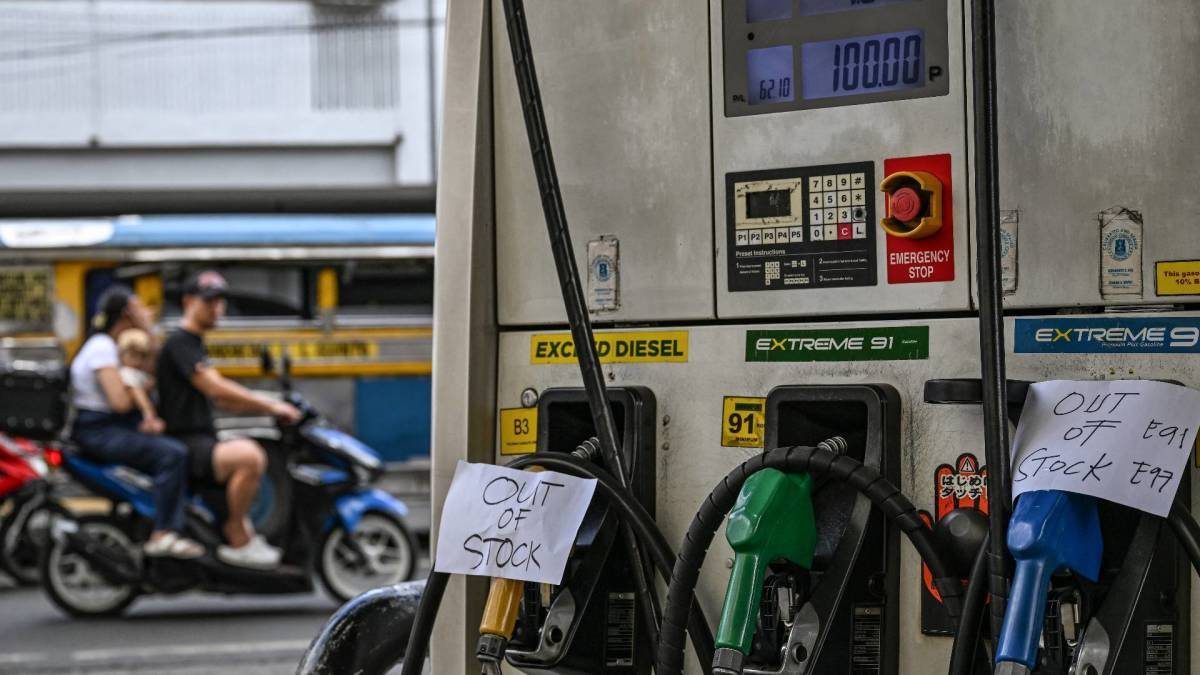
Check out the Philippines, which imports almost all of its oil and natural gas from Persian Gulf nations. The Philippine government has declared a national emergency to cope with the sudden shock of the Iran war. It's common to see gas stations with signs saying they have no gas.
To conserve energy, South Korea has told its residents to take shorter showers and charge cellphones during the day. Jet fuel prices have soared, causing havoc for Asian carriers. China has imposed export restrictions on refined petroleum products
to safeguard its own domestic supply.
The crisis is spreading and hasn't fully hit the Americas, mostly because the western hemisphere is largely self-sufficient. But it's coming, Jeff Currie says.
Jam Sta Rosa/AFP/Getty Images
The largest oil shock?
Wait a minute. Aren't crude oil prices up substantially?
Yes, indeed.
Light sweet crude, the benchmark U.S. oil traded in futures markets, was at $94.48 per 42-gallon barrel, up 4.6%, on March 26. It's up 62% this year. Brent crude, the global benchmark, settled at $101. 89, up 4.8%, for oil to be delivered in June. Brent is up 67.4% for the year.
The International Energy Agency said this week that more than 40 energy sites across nine countries in the Middle East have been “severely or very severely” damaged from the fighting, potentially prolonging disruptions to global supply chains once the war in Iran ends.
Prolonging could mean the supply chains may require months to fix.
But Currie argues that futures markets in London and New York are underpricing the real situation around the globe.
He's not alone. In a recent report, Goehring & Rozencwajg, a New York firm that specializes in investing in natural resources, the shutdown of the Strait of Hormuz "may already rank as the largest shock the (energy) industry has ever experienced."
And like Currie, the firm is very worried about what happens if the war can't be wound down soon.
So, too, is Mike Wirth, the CEO of oil giant Chevron. Futures traders are looking months and years ahead. Chevron is dealing with the now, with shortages appearing in jet fuel and diesel supplies, he said in a speech at S&P Global’s annual CERAWeek conference in Houston.
Related: Chevron CEO sends worrisome Middle East oil message
Farmers are worried because oil is used to make fertilizer. The spring planting season in the United States is just getting underway.
President Trump would like the war ended in, say, four-to-six weeks. But Israel is inflicting as much damage on Iran in advance of when Trump wants the war to end, The Wall Street Journal reported.
But it's not clear if Iran's leaders are talking to anyone in the Administration or with the Israeli government, or if the leaders much care. Pakistani officials appear to be the go-betweens for getting information to both sides.
Despite daily pummeling from Israeli and U.S. bombers and missiles. The Iranian strategy seems to be to inflict "maximum disruption on oil markets," the Goehring & Rozencwajg report says.
And that makes unblocking the Strait of Hormuz imperative, the firm said.
Related: Wall Street resets recession bets despite Fed stagflation message
Maddening and complex politics
Not so fast, argue several Gulf states tired of Iranian missiles and drones attacking their cities and oil processing and shipping facilities, The Washington Post reported on March 26. Saudi Arabia and the United Arab Emirates want a "decisive" conclusion, the report said. That means, to start, "severe restrictions on its missile, drone and nuclear programs."
Trump wants to end the war sooner rather than later, in part because a quick end solidifies Republic chances in next fall's Congressional elections. He also wants to support U.S. financial markets.
Which needs some buckling up.
The Standard & Poor's 500 Index is near 6,477. The Dow Jones Industrials is 45,960, and the Nasdaq Composite is 21,401.
All three averages are down 4%-to-6% in March, and the Nasdaq is down 10.9% from its 52-week high of 24,020, reached on Oct. 29, 2025.
Trump a winner at controlling story line
Trump has been able mostly to maintain Wall Street support with bad news at the end of a week or over the weekend followed by a bullish assessment of the war's progress early in the following week. He was saying earlier this week, Iran was begging for a deal.
We'll see. The U.S. has proposed a 15-point plan to Iran to settle the fight. It includes an open Strait of Hormuz and no Iranian nuclear facilities. Iran's leaders have rejected it. Its counter-proposal includes control of the straight and reparations.
There's a Friday deadline Trump set for Iran to get the Strait open. Remember, he said Iran's electrical infrastructure would be bombed if there is no progress. He delayed the deadline from Monday to Friday.
At the same time, the United States has been building a ground force of Marines in the region.
Looks like the conflict will be around a while
Related: Mortgage rate surge hits home buyers yet again