

Economy
25-05-2026 14:24
7 Views
Binance Wallet Launches Event Rush for On-Chain Event…
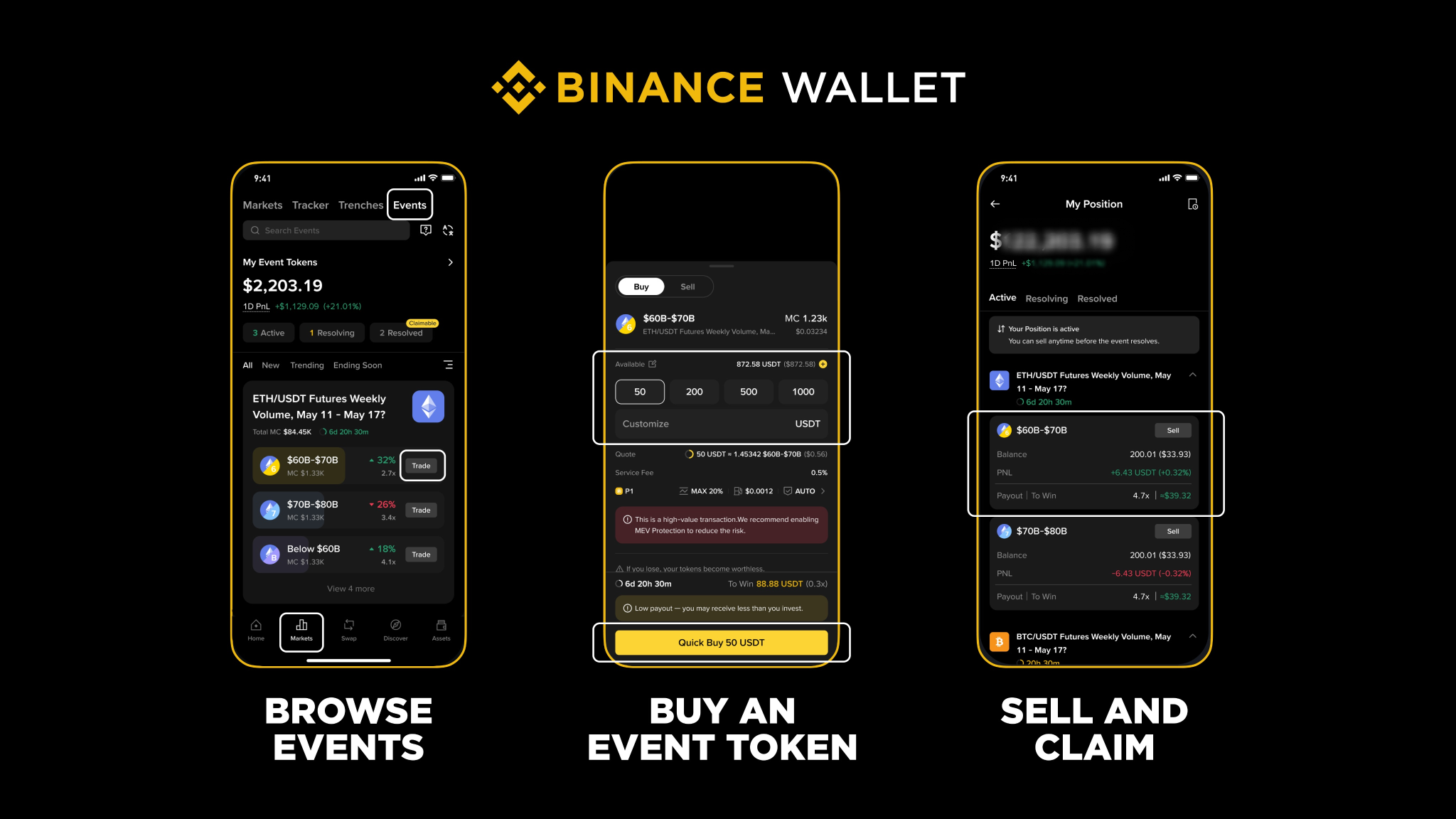
Key Facts
- Binance Wallet launched Event Rush on 25 May 2026, a third-party dApp integration for trading real-world events on-chain, built on the 42.space protocol on BNB Chain.
- Users can take positions on sports results, crypto price targets, news outcomes and more through liquid event tokens.
- Event Rush uses a bonding-curve pricing mechanism that adjusts token prices based on supply and demand, rather than the fixed odds used by traditional prediction markets, removing the need for external market makers.
- Tokens can be traded before an event resolves; holders of winning tokens at settlement split the entire USDT collateral pool, including value from losing tokens, offering uncapped upside.
- Quoted on the launch is Winson Liu, Global Head of Binance Wallet.
How Event Rush works
Unlike traditional prediction platforms, which often rely on fixed odds or fragmented liquidity, Event Rush uses a bonding-curve-based pricing mechanism that adjusts an asset's price based on demand and supply. Each trade for a possible outcome mints or redeems the corresponding event tokens against the curve. Because pricing is driven by trading activity rather than an order book, a price is always available, removing the need for external market makers. Event tokens can be traded before an event resolves, with settlement rules defined at the protocol level and tied to real-world outcomes. That design gives Event Rush a hybrid character — part tradable market, part outcome-settled prediction product — that supports both short-term trading and longer-term conviction positioning.Two ways to participate
The structure gives users two distinct routes to potential gains. The first is trading the price of event tokens before the underlying event ends — buying early and selling later if demand increases under the bonding-curve model. This creates opportunities to trade on shifts in demand, sentiment, timing or narrative, without holding a position all the way through to settlement. The second is holding through settlement. Holders of the winning event tokens split the full value of the event's collateral pool — the USDT collected across all tokens in that event, including value from losing tokens. Unlike traditional prediction markets that cap returns at a fixed payout per share, Event Rush offers uncapped upside, with rewards scaling according to how value is distributed across all outcomes. Binance illustrated the mechanic with a hypothetical sporting event: a Brazil event token accounting for 32% of the total collateral pool might offer a 2.7x return at a given moment, with both the share and the multiple changing dynamically as trading continues. The example is illustrative only.The risk side of uncapped upside
The uncapped model cuts both ways, and Binance is explicit about it. Picking the correct outcome does not guarantee a profit: a user's return depends on the total event pool, how many others also picked the winning token, and the price they paid. A holder who bought a winning token at a high price could still incur a loss if too many others crowded into the same outcome. That is a materially different risk profile from a fixed $1-per-share settlement, where a correct call always pays a known amount above cost. Winson Liu, Global Head of Binance Wallet, framed the launch around expanding on-chain access. "At Binance Wallet, we're focused on expanding access to more on-chain experiences that give users more ways to engage with emerging markets," Liu said. "Event Rush gives users a new way to express a view and participate in event-driven markets through a fully on-chain experience."Context: Binance's second prediction-market integration
Event Rush is the second event-trading product Binance Wallet has integrated in two months. In April 2026, Binance connected Binance Wallet to Predict.fun, a fixed-odds prediction market on BNB Chain where users trade yes/no shares priced between $0.01 and $0.99 that settle at $1 if correct. Event Rush takes a fundamentally different approach with its bonding-curve pricing and pooled, uncapped settlement — positioning it as a complement to, rather than a replacement for, the Predict.fun integration. Both moves reflect the same strategic logic: Binance acts as the access layer and interface while a third-party protocol handles market creation, pricing and resolution, limiting the exchange's direct infrastructure and counterparty exposure. The timing tracks a sector-wide surge — prediction-market monthly volumes have climbed from roughly $1.2 billion in early 2025 to around $20 billion, with Binance, Coinbase and Crypto.com all moving to capture share from incumbents Polymarket and Kalshi. Event Rush also continues a busy May for Binance, which has launched Pre-IPO perpetual futures, the Withdraw Protection security feature, and a QR-payments expansion. The common thread is Binance extending its surface area into novel trading and financial products built on crypto-native rails.FAQ
What is Binance Wallet Event Rush? Event Rush is a third-party dApp integration in Binance Wallet, launched on 25 May 2026 and built on the 42.space protocol on BNB Chain. It lets users trade real-world events — including sports results, crypto price targets and news outcomes — through liquid event tokens priced on a bonding curve. How is Event Rush different from a traditional prediction market? Traditional prediction markets typically use fixed odds and cap returns at a fixed payout per share. Event Rush uses a bonding-curve pricing model where token prices move with supply and demand, tokens can be traded before settlement, and winning holders split the entire collateral pool — offering uncapped upside but also the risk that a correct outcome still results in a loss depending on entry price and crowding. What are the risks of using Event Rush? Picking the correct outcome does not always produce a profit. A user's return depends on the total size of the event pool, how many other participants hold the winning token, and the price paid to enter. A user who buys at a high price could still incur a loss even if their chosen outcome wins. Event Rush is one of the more genuinely novel mechanism designs to reach a mainstream crypto wallet, replacing the binary, fixed-payout logic of prediction markets with a continuous, pooled, demand-driven model. Whether bonding-curve event trading attracts users accustomed to the clearer risk-reward of fixed-odds markets will be the practical test — and, given the contested regulatory status of prediction and event markets globally, how regulators treat an uncapped, tradable variant is the larger open question. This article is informational and does not constitute financial advice.
Other news

25-05-2026 14:24

25-05-2026 14:24