

Economy
24-06-2026 14:23
14 Views
KuCoin Pay Links Crypto to Local Rails in Bangladesh,…
Key Facts
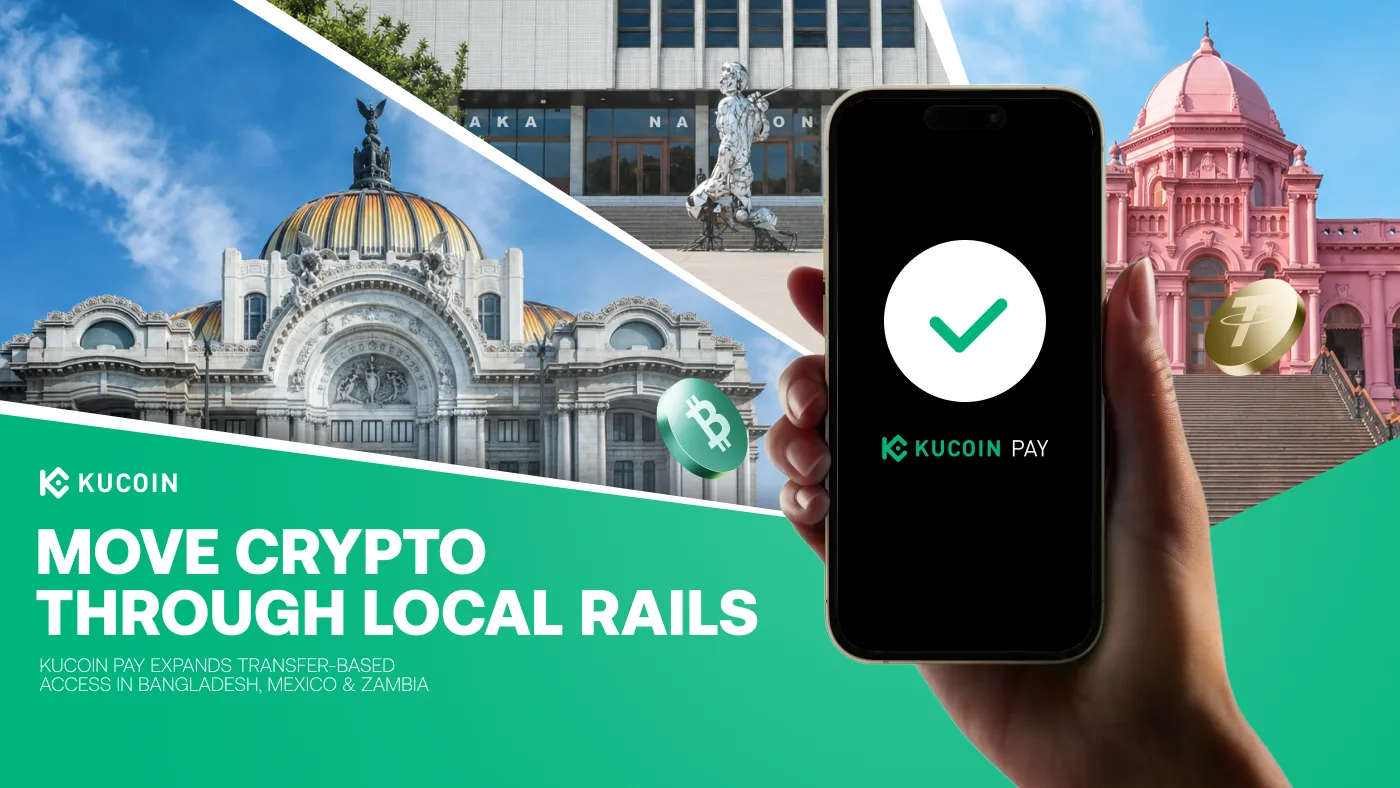
- KuCoin Pay announced on 24 June 2026 the expansion of its transfer-based payment capabilities across Bangladesh, Mexico and Zambia.
- The rollout connects digital assets with local rails: bKash and Nagad in Bangladesh, SPEI-compatible bank transfer routes in Mexico, and MTN and Airtel mobile money in Zambia.
- KuCoin Pay routes payments through local transfer environments via a single unified technical entry point, without requiring users to manage backend processes.
- The aim is to make digital asset flows feel closer to using a traditional e-wallet, mobile money service or local bank transfer tool.
- Quoted on the announcement is Alicia Kao, Managing Director of KuCoin.
Connecting crypto to familiar rails
The strategic premise is that in many high-growth markets, local bank transfers and mobile money networks have become the core way consumers move value — for salary payments, remittances, merchant transactions and peer-to-peer transfers. Rather than asking users to adopt an unfamiliar crypto-native flow, KuCoin Pay connects digital assets to the rails people already rely on, with the stated goal of letting users move digital value with fewer steps and lower friction. The choice of rails reflects each market's dominant infrastructure. In Bangladesh, bKash and Nagad are the leading mobile financial services, with bKash alone reporting over 70 million users. In Mexico, SPEI is the central bank's real-time interbank transfer system. In Zambia, MTN and Airtel operate the mobile money networks that serve a largely mobile-first population. By plugging into these rather than building parallel acceptance, KuCoin Pay meets users where their money already moves.How the routing works
KuCoin Pay is designed around deep integration with local rails, a capability it describes as localized payment routing. Rather than requiring users to manage complex backend processes, the system adapts to each local transfer environment and identifies suitable payment routes through one unified technical entry point. The intended result is that digital asset flows feel closer to using a traditional e-wallet, mobile money service or local bank transfer tool than to operating a crypto wallet. That single-entry-point design is the technical core of the announcement. For users, the complexity of mapping a crypto transaction onto a domestic transfer rail is abstracted away; for KuCoin, it creates a repeatable integration pattern that can be extended market by market as new local rails are added.Executive comment
Alicia Kao, Managing Director of KuCoin, framed the expansion around moving crypto from holding and trading into everyday financial activity. "Crypto is emerging as a new asset class with growing relevance in the real economy, and payments are one of the most important ways for this value to reach users," she said. "Through KuCoin Pay, we are building trusted and localized connections between digital assets and existing banking, mobile money and transfer rails. By integrating crypto with the financial systems people already use, we are helping digital assets move beyond holding and trading into practical financial activity, while supporting more inclusive and future-ready financial ecosystems in high-growth markets."Context: crypto meets local payment infrastructure
The rollout fits a broader industry pattern of connecting crypto to existing national payment infrastructure rather than building standalone acceptance networks. The same logic underpins Binance Pay's QR-payment expansion and Coins.ph's integration with the Philippines' QRPh standard — both bets that crypto payments scale fastest when they ride rails consumers already trust. The three target markets share a common profile: high mobile penetration, large remittance inflows, and significant populations underserved by traditional banking. Bangladesh and Zambia both lean heavily on mobile money, while Mexico combines a major remittance corridor with the SPEI real-time transfer backbone. For these markets, the practical question for crypto has always been less about access to digital assets and more about converting that value into something spendable through everyday channels — exactly the gap transfer-based routing targets. The move also extends KuCoin's broader 2026 product push beyond its core exchange, alongside its Web3 Wallet RWA integrations and Feed social layer. KuCoin Pay says it will continue strengthening compatibility with local banking and payment systems, optimising technical response speed, and expanding practical crypto payment use cases in supported markets.FAQ
What did KuCoin Pay announce? KuCoin Pay expanded its transfer-based payment capabilities across Bangladesh, Mexico and Zambia, connecting digital assets with local banking and payment rails. These include bKash and Nagad in Bangladesh, SPEI-compatible bank transfer routes in Mexico, and MTN and Airtel mobile money networks in Zambia. How does the transfer-based routing work? KuCoin Pay integrates with local payment rails and identifies suitable transfer routes through a single unified technical entry point, without requiring users to manage backend processes. The design aims to make moving digital value feel similar to using a familiar e-wallet, mobile money service or local bank transfer. Why these three markets? Bangladesh, Mexico and Zambia share high mobile penetration, significant remittance flows and populations underserved by traditional banking. Each has dominant local rails — mobile money in Bangladesh and Zambia, the SPEI system in Mexico — that KuCoin Pay connects to rather than replacing, meeting users where value already moves. KuCoin Pay's expansion underscores a maturing thesis in crypto payments: that real-world utility comes not from persuading users to adopt new payment behaviours, but from quietly connecting digital assets to the rails they already use every day. As more providers compete to bridge crypto and local payment infrastructure across high-growth markets, the differentiator will increasingly be the depth and reliability of those local integrations rather than the novelty of accepting crypto at all. This article is informational and does not constitute financial advice.
Other news
24-06-2026 14:23
24-06-2026 14:23