

Economy
01-07-2026 14:24
6 Views
Bybit Launches Bank Triparty for Bank-Held Institutional…
Key Facts
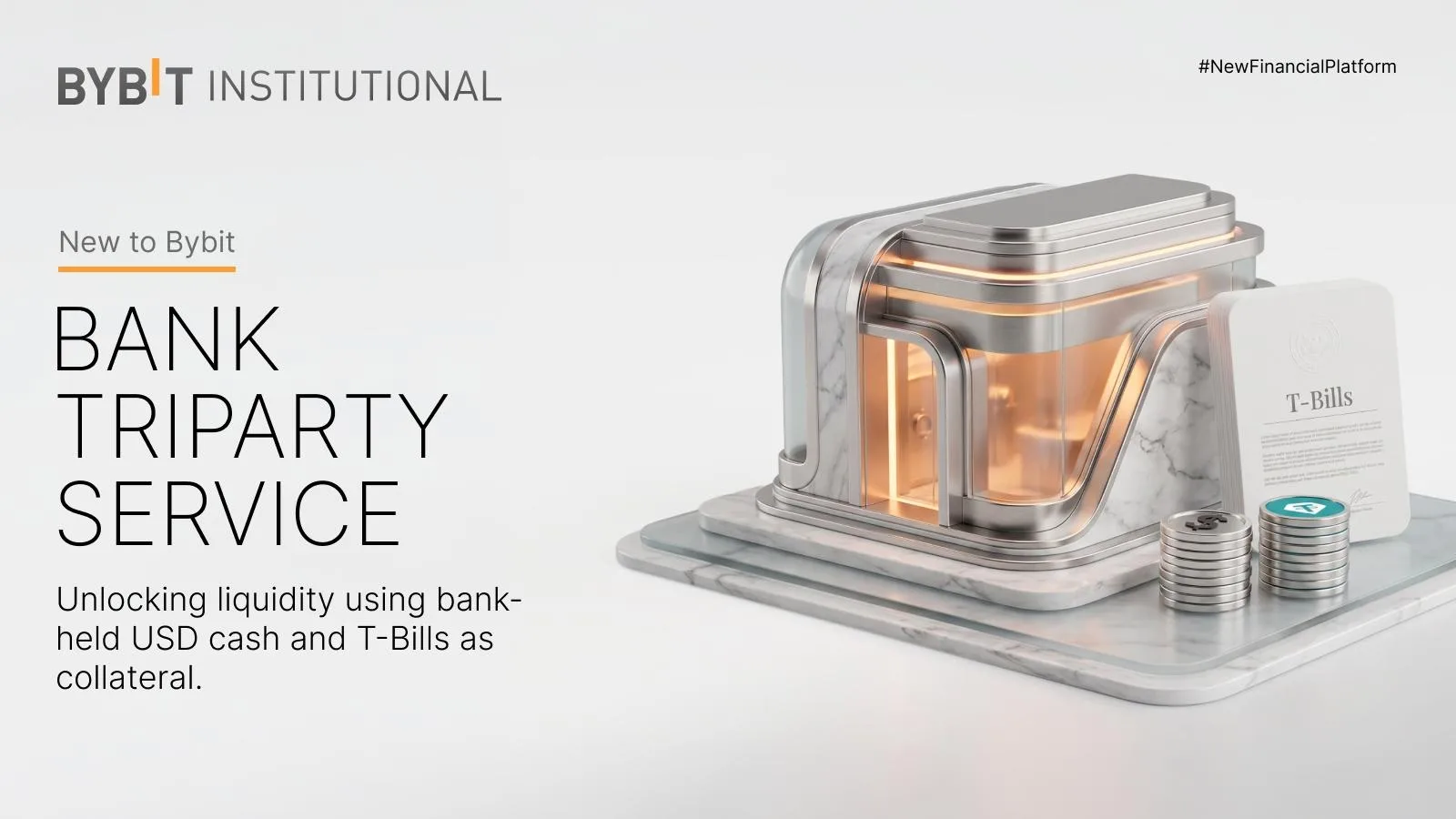
- Bybit launched its Bank Triparty service on 1 July 2026, a regulated custody solution letting institutions borrow against collateral held by independent banking partners.
- Eligible institutions deposit USD or US Treasury Bills with Bybit's designated banking partners, then receive USDT loans directly into their Bybit Unified Trading Account.
- Collateral remains in third-party bank custody throughout the term, distributing counterparty risk off-exchange.
- Institutions continue to earn yield on US Treasury Bill collateral during the borrowing period while deploying borrowed USDT across Bybit's spot, margin, perpetual and options markets.
- Onboarding is handled through a dedicated Bybit Relationship Manager; the borrowing uses lower collateral-to-loan ratios backed by cash and Treasuries.
How Bank Triparty works
The structure follows the triparty model long used in traditional finance, adapted for crypto trading. Eligible institutions deposit USD or US Treasury Bills with Bybit's designated banking partners — described as well-established international banking institutions. That deposit establishes the triparty arrangement, against which Bybit provides approved borrowing capacity. Institutions then receive USDT loans directly into their Bybit Unified Trading Account (UTA), unlocking immediate access to the exchange's trading venues without transferring collateral into any alternative arrangement. Crucially, the collateral remains in third-party bank custody throughout the term — it never moves onto the exchange. The borrowed USDT can then be deployed across Bybit's spot, margin, perpetual and options markets.Why the structure matters for institutions
The central appeal is counterparty risk mitigation. By placing collateral with an independent, regulated banking partner rather than with the exchange, Bank Triparty distributes counterparty risk off-exchange — addressing one of the most persistent institutional objections to trading on centralised crypto venues. An institution's principal collateral is insulated from the exchange's own balance-sheet risk, held instead by a regulated bank under a triparty agreement. That structure directly answers a concern sharpened across the industry since the failures of 2022 and 2023, when commingled or exchange-held collateral left institutional participants exposed to platform insolvency. Keeping collateral in independent bank custody is the model traditional prime brokerage has always used, and Bybit is now importing it into crypto trading.Capital efficiency and yield preservation
Beyond risk, the framework is built for capital efficiency. Institutions receive immediate USDT financing without transferring or restructuring collateral, reducing fees and potential delays. Because the borrowed liquidity flows straight into the existing UTA, institutions can deploy additional capital across Bybit's markets without modifying their existing infrastructure or operational setup. A further advantage is yield preservation. US Treasury Bill collateral continues accruing its APR throughout the lending period, so institutions earn yield on their posted collateral at the bank and unlock borrowing capacity for trading at the same time. That dual benefit — collateral working in two places at once — is the efficiency argument at the heart of the product, and it is underpinned by prudent risk parameters, with lower collateral-to-loan ratios backed by USD cash and US Treasury securities.Context: Bybit's institutional push
Bank Triparty is the latest in a sequence of moves aimed at deepening Bybit's institutional offering. The exchange has expanded its institutional loan program, refined its collateral tier structure, and built out the account architecture that lets professional participants trade on terms closer to those of traditional finance. The exchange has also emphasised institutional-grade controls elsewhere in its product line, including the AI Subaccount for isolating trading agents and its move to single-counted open interest reporting for cleaner institutional data. The common thread is Bybit positioning itself for the institutional capital that has entered crypto markets through spot ETFs and tokenised real-world assets — capital that brings traditional-finance expectations around custody, counterparty risk and reporting. Bank Triparty is a direct response to those expectations, importing a settlement structure institutions already understand rather than asking them to accept exchange-held collateral. It also arrives against a backdrop of tightening institutional risk discipline; Galaxy Research's recent work on crypto leverage documented a broad move toward higher collateral quality and away from the undercollateralised lending that characterised earlier cycles.FAQ
What is Bybit Bank Triparty? Bank Triparty is a regulated custody service launched by Bybit on 1 July 2026. It lets eligible institutions deposit USD or US Treasury Bills with independent regulated banking partners and receive USDT loans directly into their Bybit Unified Trading Account, while the collateral remains in third-party bank custody throughout the borrowing term. How does it reduce counterparty risk? By keeping collateral with an independent, regulated banking partner rather than on the exchange, Bank Triparty distributes counterparty risk off-exchange. The institution's principal collateral is held by a regulated bank under a triparty agreement, insulating it from the exchange's own balance-sheet risk while still enabling trading access. Can institutions still earn yield on their collateral? Yes. US Treasury Bill collateral continues accruing its APR throughout the lending period. This lets institutions earn yield on collateral held at the banking partner while simultaneously deploying borrowed USDT across Bybit's spot, margin, perpetual and options markets — collateral effectively working in two places at once. Bank Triparty is a clear signal of where competition among major crypto venues is heading: not on retail features, but on whether an exchange can offer institutions the custody and counterparty-risk protections they take for granted in traditional markets. As institutional capital continues to flow into digital assets, bank-held collateral structures like this one are likely to become a baseline expectation rather than a differentiator. This article is informational and does not constitute investment advice.
Other news

01-07-2026 14:24

01-07-2026 14:24