

Economy
21-07-2026 14:24
8 Views
SEC Regulation Crypto: The $75 Million Token Sales Proposal…
What SEC Regulation Crypto Actually Proposes
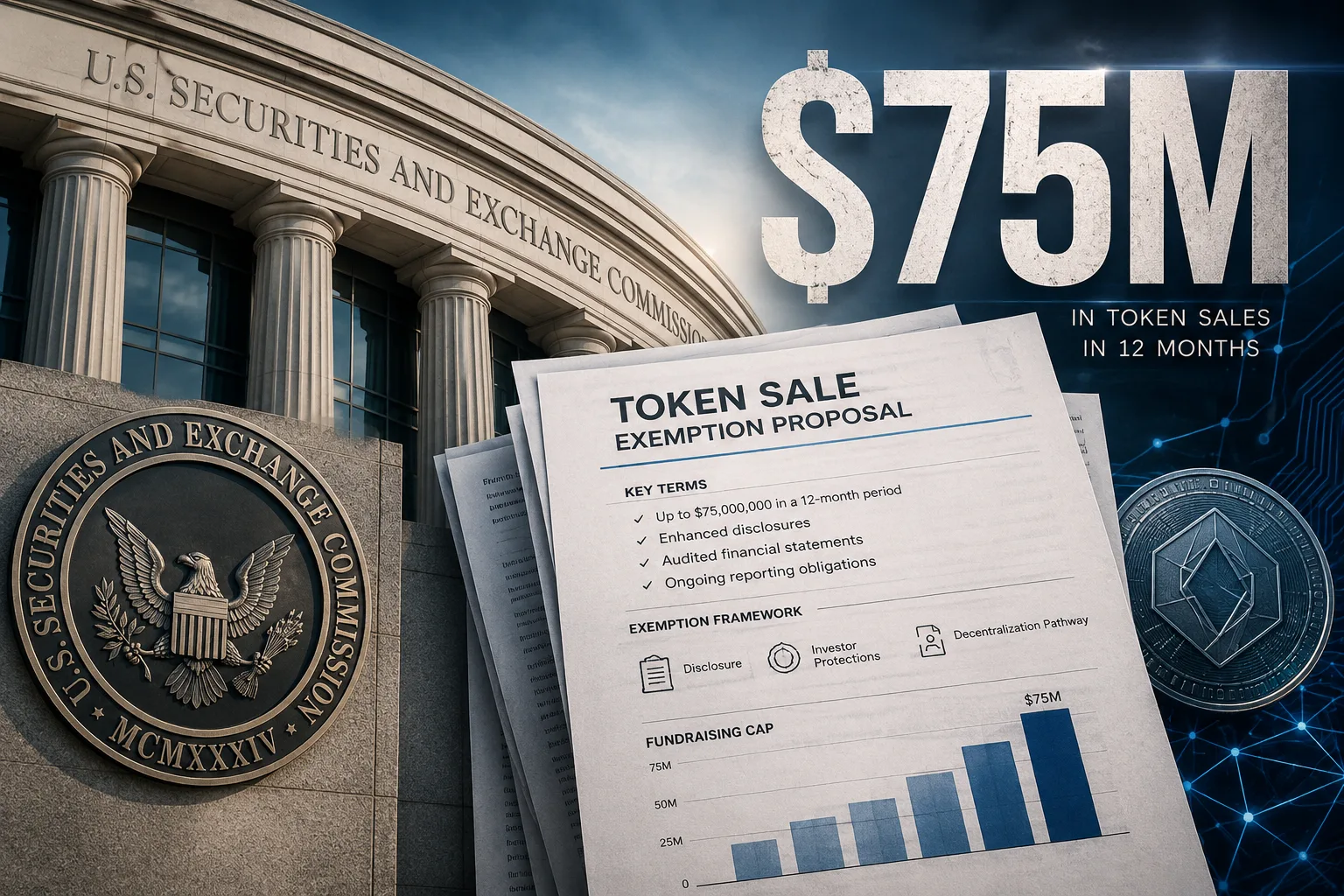
The framework described by Atkins has three distinct parts, and the differences matter. The first is a time-limited startup exemption for offerings of investment contracts involving certain crypto assets. Atkins suggested that it could last for up to four years and allow developers to raise an illustrative $5 million while building a network toward maturity. Projects could be required to notify the SEC when entering and leaving the exemption and publish principles-based disclosures resembling the information commonly found in token white papers. The second part is the proposed fundraising exemption behind the $75 million headline. Atkins said entrepreneurs could be allowed to raise up to a defined amount, “say $75 million,” in any 12-month period while retaining access to other exemptions under federal securities laws. An issuer relying on this route could have to file a disclosure document covering the token and investment contract, its financial condition and financial statements. The contemplated route would therefore not amount to an unregulated token sale. It would replace full registration with a tailored disclosure regime designed around crypto fundraising. The distinction is important because the four-year period applies to the smaller startup concept described in the speech, while the $75 million figure belongs to a separate fundraising exemption. Until the Commission publishes the proposing release, the final cap, eligibility criteria, resale conditions, disclosure standard and exclusions remain unknown.The $75 Million Token Sales Exemption
A $75 million annual ceiling would be large enough to cover many token launches that previously faced a difficult choice between registering a securities offering, limiting distribution under an existing exemption or launching outside the United States. It would also exceed the scale normally associated with an early-stage safe harbor. For brokers, trading venues, custodians and compliance providers, the practical opportunity would be a new class of US-facing crypto issuers operating under a standardized filing and disclosure framework. The $75 million figure also matches the annual fundraising ceiling under Regulation A Tier 2, commonly referred to as Reg A+ Tier 2. That comparison provides a practical indication of what the compliance burden could look like. Reg A+ Tier 2 issuers can raise up to $75 million during a 12-month period, but they must generally provide audited financial statements and continue filing annual, semiannual and certain current reports. Regulation Crypto Assets may not reproduce those requirements exactly, but the matching threshold suggests that the proposed token-sale route could involve a substantial disclosure and reporting framework rather than a light-touch exemption. The number should not be treated as final. Atkins described it as an example of a “defined amount,” not as a Commission-approved threshold. That means the eventual proposal could set a lower or higher ceiling, divide the exemption into tiers or impose conditions based on investor type, project maturity or insider ownership. The formal text will also determine whether exchanges can rely on an issuer’s filing or must conduct an independent assessment before listing the token. The SEC framework would sit alongside legislation being developed in Congress. Atkins said Regulation Crypto Assets would draw heavily from the Digital Asset Market Clarity Act. The House bill creates a disclosure route for investment contracts involving units of digital commodities and a process for certifying a blockchain system as mature. Its text requires information on source code, token economics, ownership, development plans, governance and material risks. It also allows the SEC to challenge a maturity certification within a specified review period.The One Big Catch: When Does The Investment Contract End?
The most contested part of Regulation Crypto Assets is likely to be the proposed investment contract safe harbor. Atkins said it could apply once the issuer has completed or permanently ceased all of the essential managerial efforts it represented or promised under the investment contract. The goal is to give issuers and market participants a rule-based standard for determining when a crypto asset is no longer subject to federal securities laws through that contractual relationship. That sounds like a bright line, but the difficult questions are factual. A project may claim that its core development work is complete while founders retain governance influence, control treasury assets, fund developers or promote adoption. A foundation may replace the original issuer without eliminating managerial dependence. Software upgrades, token incentives and emergency interventions may also revive activity that appeared to have ended. Issuers will have an incentive to argue that the safe-harbor conditions have been met, while exchanges and brokers will have to decide whether relying on that conclusion exposes them to registration risk. The CLARITY Act attempts to address a related problem through its mature blockchain framework. Its certification provisions focus on whether a blockchain is controlled by a person or group under common control, the operation of the system, the token’s functionality, governance and the continuing roles of issuers and affiliated parties. Regulation Crypto Assets may borrow from those concepts, but Atkins’ speech did not specify whether the SEC would require a formal certification, permit self-certification, impose a waiting period or create a procedure for challenging an issuer’s exit from securities treatment.How The GENIUS Act Changes The SEC Crypto Perimeter
The framework also depends on separating payment stablecoins from other crypto assets. Atkins said the SEC’s taxonomy treats payment stablecoins regulated under the GENIUS Act as a category that is not deemed a security. The legislation establishes federal and state supervisory routes for permitted payment stablecoin issuers, including application processes, regulatory standards and rulemaking responsibilities for banking and state authorities. That carve-out narrows the question Regulation Crypto Assets is trying to answer. Payment stablecoins would primarily follow their own prudential framework, tokenized traditional securities would remain securities, and the disputed territory would center on non-security crypto assets sold through investment contracts. For issuers and exchanges, the result could be a more defined regulatory map, but only if the boundaries between these categories are operationally clear.What Issuers And Exchanges Should Watch Next
The first document that matters is the SEC proposing release. Market participants should compare it with Atkins’ speech rather than assuming the illustrative figures and concepts survived unchanged. The central points will include the final fundraising cap, issuer eligibility, disclosure liability, treatment of insiders, resale rules, exchange obligations and the procedure for determining that essential managerial efforts have ended. Even if the SEC publishes the proposal in July, the $75 million exemption will not become available immediately. The Commission must first release the proposed rule, open a public comment period, review the submissions it receives and decide whether to revise the text. The SEC would then need to approve a final rule and establish effective and compliance dates. The process is therefore likely to be measured in quarters rather than weeks. Issuers considering the exemption should already be documenting every promise made to purchasers, every continuing development obligation and every form of control retained by founders or related entities. That record may later determine whether a project can show that its essential managerial efforts have ended. Exchanges will need listing standards that test more than an issuer’s assertion that a token has matured. Brokers, custodians and payment providers will also need to determine which representations they can rely on and when a change in governance or development activity requires a new legal assessment. The $75 million figure may attract the most attention, but the safe harbor will determine whether Regulation Crypto Assets creates durable certainty. A fundraising exemption can open the door to token sales. A workable exit test decides whether the token can ever leave the securities framework behind.
Other news

21-07-2026 14:24

21-07-2026 14:23