AMD stock surges after Meta agrees to giant $100B AI chip deal
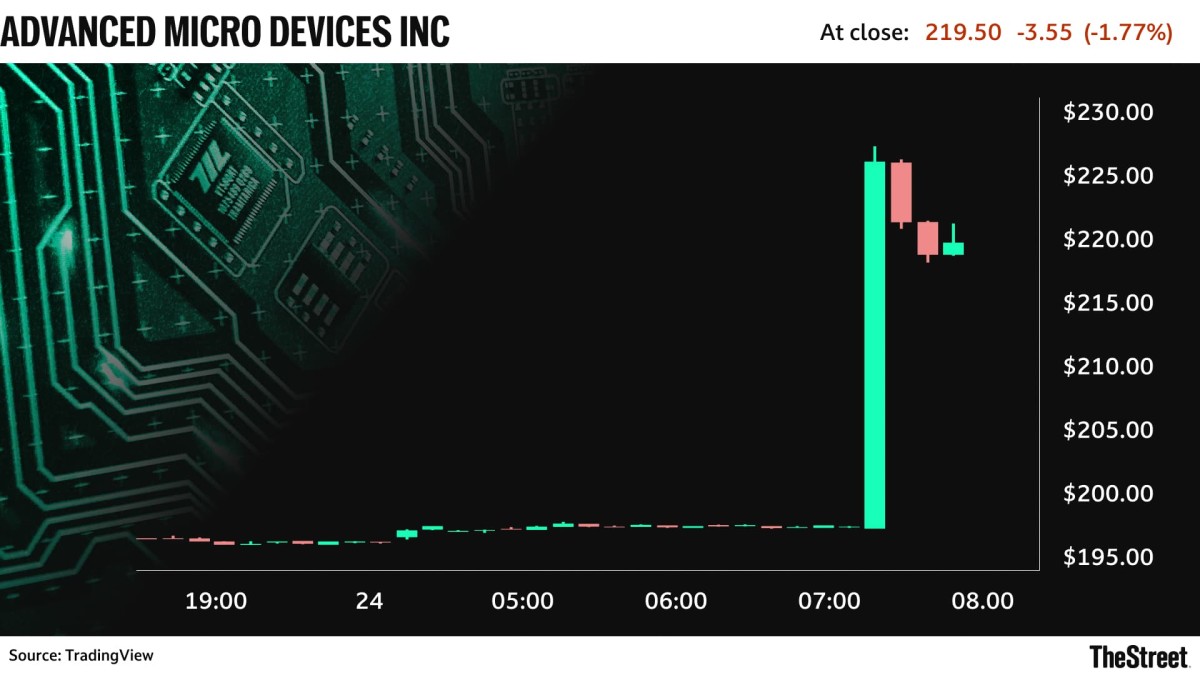
Advanced Micro Devices (AMD) just carved itself a real seat at the table in artificial intelligence. Shares jumped more than 9% before the February 24th market open after Meta Platforms agreed to source massive volumes of AI chips from the chipmaker in a multi-year deal.
For investors, this was not just another supply contract. It looked a lot like proof that AMD can finally compete in the most profitable corner of semiconductors, a space Nvidia (NVDA) has owned almost exclusively for two years.
The deal is structured around six gigawatts of AMD Instinct computing power. The Wall Street Journal reports it could be worth more than $100 billion, with each gigawatt of compute alone worth tens of billions in revenue for AMD. Shipments for the first gigawatt deployment are set to begin in the second half of 2026.
What the Meta deal actually includes for AMD investors
The scope of this agreement goes well beyond chip sales. Meta will receive AMD's custom Instinct MI450 graphics processing units, according to Tom's Hardware, EPYC CPUs, and AMD's Helios rack-scale architecture to power its data centers.
There is also a significant equity component. AMD issued Meta a performance-based warrant for up to 160 million shares of its common stock at $0.01 each, which could hand Meta roughly a 10% stake in AMD if purchasing milestones are fully met.
TradingView
AMD CEO Lisa Su framed the deal as a direct competitive response to Nvidia. Su told reporters, according to Fortune: "Meta has a lot of choices. I want to make sure that we are always a clear seat at the table when they think about what they need next." Meta CEO Mark Zuckerberg added that he expects "AMD to be an important partner for many years to come."
Why investors bought in fast
- The deal validates AMD's Instinct GPUs as real competition for Nvidia's data center chips, not just a cheaper fallback option.
- It adds Meta to a growing list of hyperscaler buyers that includes Microsoft and Oracle, widening AMD's customer base.
- AI chips carry much higher margins than traditional CPUs. Scaled shipments could push AMD earnings estimates significantly higher.
- Analysts called it "a shot across the bow" for Nvidia, signaling a real shift in how hyperscalers are diversifying AI supply chains.
What this means for Nvidia's dominance
Nvidia is not losing its crown. It still controls the vast majority of AI accelerator revenue, dominates training workloads, and owns the CUDA software ecosystem that most AI research runs on. Its hardware remains the standard for cutting-edge models.
But it is losing exclusivity, and that matters. If large buyers like Meta can split their orders between two credible suppliers, Nvidia's pricing leverage weakens over time. Not today. But markets trade on trajectories, not just the current moment.
Notably, Meta announced a partnership with Nvidia just days before the AMD announcement. Meta is not picking sides. It is building optionality, and that strategic move puts both chipmakers in a more competitive position going forward.
The software battle could decide who wins long term
Hardware is only half the fight. Nvidia's CUDA software platform has been built up over more than a decade and is deeply embedded in AI research and production pipelines worldwide. AMD's alternative, ROCm, has improved steadily but is still considered behind.
More Tech Stocks:
- Morgan Stanley sets jaw-dropping Micron price target after event
- Nvidia’s China chip problem isn’t what most investors think
- Quantum Computing makes $110 million move nobody saw coming
Meta's decision to build real infrastructure around AMD's stack sends a signal that ROCm is now capable enough for serious production workloads. That matters far beyond this one deal.
What investors will watch at AMD's next earnings report
- How much of AMD's data center revenue can be directly tied to AI accelerator shipments.
- Gross margin trends, particularly as AI chip production scales up.
- Any new hyperscaler customer announcements that confirm the Meta deal is part of a broader pattern rather than an isolated win.
The risks investors should not ignore
A strong stock reaction does not erase execution risk. AMD must deliver the MI450 chips on time, scale production reliably, and support customers with competitive software tools throughout the deployment. Any stumble there could chip away at the credibility this deal is meant to build.
There is also a valuation concern. AI optimism has already pushed semiconductor stocks to rich multiples. Any pullback in hyperscaler capital spending could hit sentiment fast and hard. Meta itself has a history of swinging its capital spending targets based on ad revenue and shifting strategy priorities.
The deal is also not a guarantee. The $100 billion figure reflects the full six-gigawatt scenario. If Meta scales back its AI buildout, the actual revenue AMD collects will fall well short of that ceiling.
AMD did not dethrone Nvidia on Tuesday. But it forced its way into a fight that, until recently, only had one serious participant. In a market that rewards momentum and narrative shifts, that alone was enough to move billions of dollars in a single session.
Related: Meta makes major bet on AI secret weapon