

Economy
02-03-2026 14:29
1 Views
Bitunix Futures Trading Explained (Up to 200x)
Futures Contracts And Settlement Basics
Bitunix futures mainly differ by what you post as collateral and what currency you receive as profit and loss (P&L).USDT M Perpetuals
USDT stands for Tether, a stablecoin designed to track the US dollar. With USDT margined perpetuals, you use USDT as margin, and your P&L settles in USDT. This setup makes budgeting easier because your collateral does not swing like a coin does.USDC M Perpetuals
USDC stands for USD Coin, another dollar-linked stablecoin. Bitunix has launched USDC margined perpetual futures, where USDC is also used for margin and settlement. The platform also notes it can adjust trading parameters based on market risk, such as leverage and margin requirements.Coin M Perpetuals
Coin-margined perpetuals use the underlying coin as collateral and settlement. Bitunix describes this as coin-denominated margin and settlement, where your P&L is realized in the same coin you post. That can suit traders who measure performance in coins, but it adds a twist. Your collateral value can drop at the same time your position moves against you.What Up to 200x Leverage Means
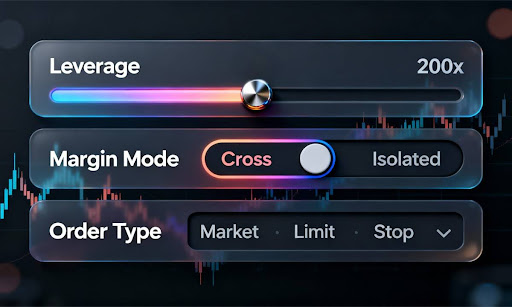
Leverage controls how much exposure you get per unit of margin. Bitunix ties maximum leverage to tier rules. The 200x headline applies to specific tiers on specific pairs, and the limits get stricter as nominal position value increases. Here is the practical point. Higher leverage brings liquidation closer to entry, so you have less room for noise. A small move that feels harmless on spot can end a high-leverage position. On Bitunix futures, treat high leverage like a scalpel. Useful for very specific cuts. Bad for casual waving around.Cross Margin vs Isolated Margin
Bitunix supports two margin modes. Cross margin uses the assets in your futures account as shared margin for all cross-margin positions. If forced liquidation triggers, all cross-margin positions can be liquidated together. Isolated margin keeps each position separate. Liquidation in one position does not automatically affect the others. A quick rule that keeps beginners out of trouble is to use isolated margins when you want one trade to stay in its own lane. Use a cross when you understand how positions interact, and you want a shared margin.Order Types and What to Expect in Fast Markets
Bitunix supports common order types such as market and limit orders, and it supports take-profit and stop-loss orders that trigger at a preset price. Take profit and stop loss (often shortened to TP/SL) work like this. You set a trigger price. When the market reaches it, the system submits the exit order. Two warnings straight from the rules of reality. In sharp volatility, trigger orders can fail due to restrictions or system limits, and triggered limit orders can remain unfilled. Bitunix also added options for selecting trigger price types, such as mark price versus latest price, in its advanced TP/SL settings.Risk Limits And Maintenance Margin
Maintenance margin is the minimum margin you need to keep a position open. Bitunix defines the maintenance margin rate that way, and it notes that forced liquidation happens when available margin falls below maintenance margin. Bitunix also uses tiered maintenance margin rules. As position size increases, maintenance margin rates rise, and maximum leverage drops. The stated goal is to reduce the market impact of large forced liquidations.Liquidation, Mark Price, And Why Leverage Feels Harsh
Forced liquidation triggers when the marker price reaches your liquidation price, and your margin cannot meet the requirement for position maintenance. That marker price is built to be more stable than the last traded price. Bitunix calculates an index price using spot prices from multiple exchanges and excludes outliers beyond a set deviation in many cases. The mark price then uses the index price plus funding-related components, which helps reduce unnecessary liquidations during illiquidity or manipulation.Higher leverage moves the liquidation price closer to your entry.
Funding Payments And Holding a Position
Perpetual futures use funding to keep contract prices anchored to spot. Bitunix describes the funding fee as the position value multiplied by the current funding rate. When the rate is positive, longs pay shorts. When it is negative, shorts pay longs. Funding is usually charged every 8 hours at 00:00, 08:00, and 16:00 in Coordinated Universal Time (UTC). The help center also notes that the schedule can change for certain pairs based on market conditions.Conclusion
Bitunix futures trading adds more than direction. You trade perpetual contracts margined in USDT, USDC, or the underlying coin, with leverage up to 200x on BTC and ETH under tiered risk limits. You also choose cross or isolated margin, order types, and manage funding, plus mark-price rules that drive liquidation. And if you trade Bitunix futures, remember the boring stuff is the important stuff. Tier rules, mark price, and funding times decide what happens when the market stops being polite. If you want to get started, create your account on the Bitunix sign-up page.
Other news
02-03-2026 14:29
02-03-2026 14:29