Grocery chain cuts prices as value war heats up
raditional grocery stores face competition on multiple fronts, creating a price-driven, margin-squeezing battle for market share.
They have always had to fend off warehouse clubs including Costco and Sam's Club while battling Walmart and Target, which have increased their investment in the grocery space in recent years.
Now, supermarkets also have to battle competition from dollar stores and Amazon, which has pulled back from non-Whole Foods grocery stores, but has doubled down on quick delivery.
That has created an incredibly challenging market.
"U.S. grocery consumers are increasingly focused on low prices...To win greater market share, they need to differentiate themselves on at least one of these fronts — and preferably more: quality products, including fresh food offerings, and a favorable shopping experience," according to industry analyst Boston Consulting Group (BCG).
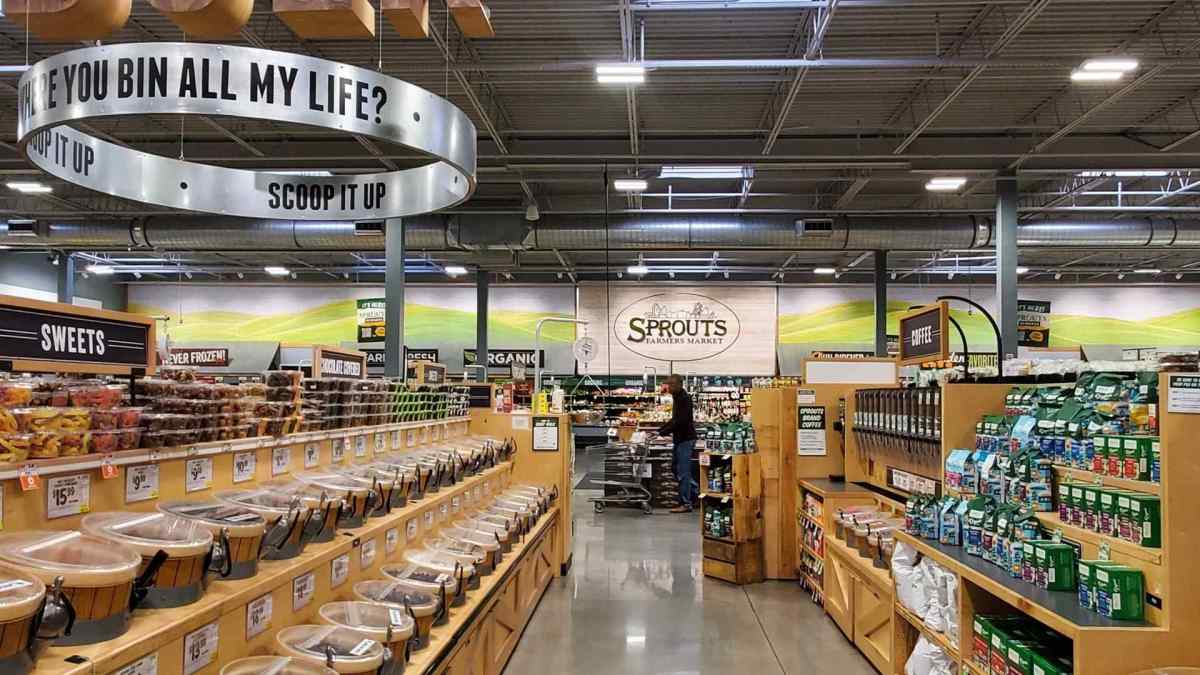
Sprouts Farmers Market has always offered a differentiated shopping experience, but its CEO Jack Sinclair said during the recent Roth Conference that it has to do better when it comes to value.
Sprouts operating from a position of strength
While many grocery chains struggled as consumers have pulled back on their spending, Sprouts actually had a very strong year.
“Sprouts delivered strong growth in 2025," Sinclair said in the chain's fourth-quarter earnings release. "These results were a testament to the strength of our business and our team's commitment to serving our unique target customer. We are committed to helping our customers live and eat better and remain laser focused on executing our strategy in the coming years."
Sproutsfull year highlights:
- Net sales totaled $8.8 billion; a 14% increase from 2024
- Comparable store sales growth of 7.3%
- Diluted earnings per share of $5.31; compared to diluted earnings per share of $3.75 in 2024
- Opened 37 new stores, resulting in 477 stores in 24 states as of December 28, 2025
The company also has a strong cash position.
- Ended the year with $257 million in cash and cash equivalents and zero balance on its $600 million revolving credit facility.
- Authorized a new $1 billion share buyback program and repurchased 4 million shares of common stock.
- Generated cash from operations of $716 million and invested $224 million in capital expenditures, net of landlord reimbursement.
Source: Sprouts Investor relations
Despite that, Sprouts' guidance predicted a drop in same-store sales in the first quarter between 1% and 3%.
Sprouts sees room to improve
During the Roth Conference Sinclair made it clear that Sprouts has to offer a better value proposition for customers.
"And as you look at going forward, the challenges of gas pricing and some of the dynamics that are going on at the moment, we've got to work hard at making sure our affordability of the products that we're selling our value," he said.
Value, Sinclair noted, isn't just about having low prices.
"And value, meaning at any price point as opposed to trying to change the profile of our price points in the business. So we're focused very much on value. We think that will help us with traffic going forward. We're very confident in our margin profile," he added.
Sinclair also shared that Sprouts' product mix gives it an edge over rivals.
"We've got differentiated products. So that makes the price comparisons in what you invest in are a little bit different for the world," he said.
More Retail:
- Walmart fires OpenAI in playbook-changing move
- Costco CEO just gave members a new reason to renew
- Bath & Body Works makes big change customers will notice right away
That's not true in all areas of the store.
"I've lived in through my career in a grocery world where everyone's got the same thing, you're always looking at everyone else's prices. We do so in produce. So we're looking hard in a very volatile marketplace, making sure our value in organic produce is significantly better than anyone else in the industry," he shared.
Shutterstock
Americans want value when buying groceries
Americans have been trading down when it comes to groceries, according to BCG's data.
- 31% of consumers say that rising prices have made them switch to a lower-cost or discount grocer.
- 46% of consumers are purchasing more store brands than in the past in order to save money.
Outgoing Dollar General CEO Todd Vasos noted that his chain has seen a wider array of people shopping its stores, but they all want the same thing.
"Customers across all income brackets continue to stress the importance of finding value as they shop, and we are meeting this need as we continue to grow penetration with households of all income levels," he said during Dollar General's fourth-quarter earnings call.
PwC sees the grocery space as getting even more challenging for operators.
"Grocery retailing is a dynamic and highly competitive industry, and it’s becoming more so," the research firm shared.
PwC also sees the need to deliver value as a long-term proposition grocery chains must embrace.
"From the shoppers’ perspective, the recession or at least 'recession-like' behavior will not end soon, if ever. Shoppers’ value-seeking behaviors have become ingrained. At the same time, digital technologies will make 'price shopping' ever easier and more convenient, and the Internet and other new formats will drain volume away from traditional channels," according to PwC's Four forces shaping competition in grocery retailing
Related: Shoe brand once worth $4B closes all stores, avoids bankruptcy