Iconic national office retailer closing stores, no bankruptcy
Amazon’s skyrocketing success had a disruptive effect on traditional sales in the global retail industry.
The e-commerce giant removed the need for physical presence. Pair that with a harsh economic climate — and for the knockout, the Covid lockdowns — to get a realistic picture of brick-and-mortar retail's struggles.
The traditional retail office-supply market is a good example. Industry data reveal U.S. office supplies sales revenue across physical and digital retail channels totaled $11.5 billion in 2024, suggesting a 5% year-over-year decline, as total unit demand dropped 2%, according to Circana.
Two large forces remain in the office-supply industry, even though Amazon’s private label, Amazon Basics, captures 12% of online office supply sales, according to data from WifiTalents.
One of them, Office Depot, saw ownership changes in 2025, and the other, Staples, is also making drastic operational moves.
Many workers still want office supplies, preferring handwritten notes
While the traditional retail office-supply market is struggling, the future of the overall industry doesn't look bleak. Staples and Office Depot combined still account for 33% of the U.S. market.
Key office supplies industry statistics
- Market growth: It's valued at $183.07 billion (2025) and projected to hit $186.71 billion (2026) with a 1.01% CAGR.
- E-commerce: Online sales now drive 28% of total industry revenue.
- Paper products: These supplies maintain a dominant 35% share of global revenue.
- Desk supplies: Items such as staples and clips capture 12% of the global market.
- Logistics: Global shipping and supply chain costs surged 15% in 2022.
- Retail leader:Walmart remains the top U.S. brick-and-mortar source for low-cost stationery.
- Strategy changes: Office Depot has closed 200 stores since 2020 to prioritize B2B distribution.
Sources: Fortune Business Insights, WifiTalents
Industry data make it clear that the market for office supplies isn’t going anywhere. In fact, WifiTalents data also reveal that 40% of office workers still prefer handwritten notes, despite using digital tablets.
Office Depot shifts toward business-to-business (B2B) operations
While the future of the industry is stable, the way these retailers operate is changing significantly. A key example is Office Depot, which was sold to Atlas Holdings for around $1 billion, or roughly the same amount the office chain paid to acquire rival OfficeMax more than a decade ago.
“This transaction, fully supported by our Board, provides a substantial premium for The ODP Corporation’s shareholders and will improve the company’s position for the next phase of growth," ODP Corporation CEO Gerry P. Smith said at the time.
"Atlas brings an understanding of our industry, along with the operational expertise, resources and track record of supporting its companies that will fast forward our B2B growth initiatives and strengthen our position as a trusted partner to our customers.”
“In 2024, ODP reported revenue of $7 billion, a far cry south of its post-merger total and revenue of $11.7 billion 10 years ago in 2015,” explained long-time Wall Street analyst and TheStreet Co-Editor-in-Chief Todd Campbell.
Office Depot has closed more than 1,000 stores since its 2013 merger, reducing its store count by about 55%. Given the declines, it was understandable that Office Depot agreed to be acquired.
Even before the acquisition, Office Depot had shifted its strategy to business-to-business (B2B). In fact, its Business Solutions unit, a B2B distribution and e-commerce platform, now accounts for more than half of the company’s revenue.
“In the first six months of 2025, the unit generated 52% of total sales. That’s up from 51.3% a year earlier, driven by slower declines in B2B compared with retail,” reported Digital Commerce 360.
Meanwhile, its biggest rival is going through a change of its own.
Staples has struggled over the last two decades
Huge retailers often close stores to optimize operations or experiment with new models, including online sales, meaning that closures of a few stores don’t always indicate struggles.
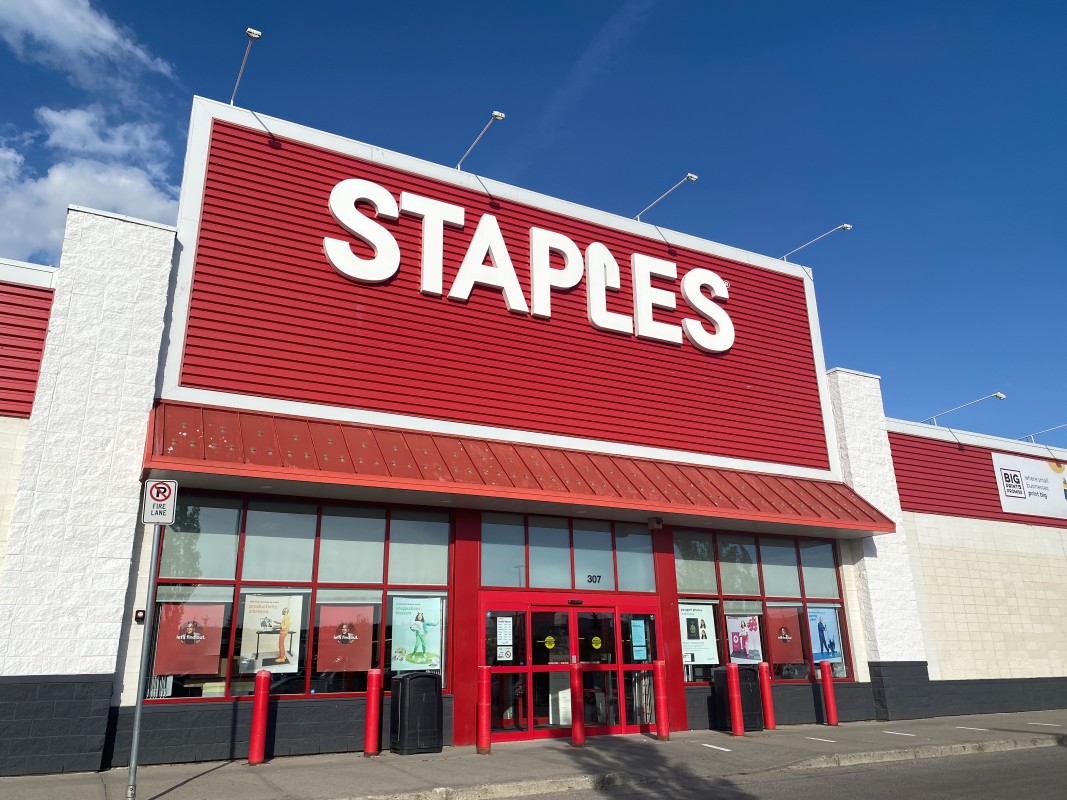
However, Staples has undergone an ownership change along with a massive wave of closures.
According to recent reports, the store closings are not over.
For more than three decades, Staples has been a cornerstone of the office-supply industry, from its 1986 debut in Brighton, Mass., to becoming a Fortune 500 company in just 10 years. While it built a legacy on furniture and tech, the "Amazon effect" eventually forced the company to begin downsizing its physical footprint in 2014.
More Retail:
- Dollar General makes key move Target, Walmart can’t beat
- Discount retail chain suddenly closes multiple locations
- Lowe’s makes major change to how you interact with its stores
“Staples CEO Ron Sargent said that customers were using fewer office supplies and migrating to online shopping, reducing the ability to sell add-on items and making them more value-conscious," The Motley Fool’s Dan Caplinger reported back in 2014. "In response, Staples will close about 225 stores by 2015, with expectations to cut costs by $500 million as a result.”
In 2015, Staples attempted a massive merger with Office Depot, but federal regulators blocked the deal on antitrust grounds, prompting Staples to pivot away from traditional storefronts toward high-volume B2B services.
This strategic shift led to the company being taken private in 2017 by Sycamore Partners for $6.9 billion.
The acquisition was heavily financed by debt, followed by a $5.4 billion refinancing in 2019. However, the firm’s management of Staples has faced significant scrutiny.
Shortly after the takeover, Sycamore Partners issued itself a $1 billion dividend — an exceptionally large payout that allowed the private equity firm to recoup roughly 80% of its initial investment in less than two years, according to Bloomberg.
Staples closes 13 stores in four months as it shifts focus to online and B2B
I previously covered several Staples closures in 2025, when it shuttered three Connecticut stores in Newington, Norwich, and Norwalk, as well as its only store in Minnesota.
Its U.S. footprint shrank from 929 stores in October 2025 to 916 by January 2026 — a net decline of 13 locations in four months, according to ScrapeHero data.
The latest closures, confirmed in February 2026, are part of Staples' ongoing plan to reduce its physical footprint as a growing portion of its business shifts to online sales or B2B.
The Staples located at 5557 Urbana Pike (Riverview Plaza) in Frederick, Md., is closing for good on March 6, 2026, reported The Mocoshow. The store has been open for more than 20 years.
The news follows the closure of another nearby location in Germantown about six months ago.
Another Frederick-area Staples, located at 1305 W. 7th Street, will remain open, a representative from that store confirmed to The Mocoshow.
Another Staples store, in Waterville, Maine, will permanently close on April 10, 2026, reported 94.9 WHOM. The signs placed on the store’s door explain that the Staples locations in Augusta and Bangor will remain open.
Similarly to the Maryland closure, this is part of Staples' broader strategy to move away from smaller-town retail stores as it strengthens its online and B2B strategy.
Staples launches new efforts and retail partnerships to draw more customers
While circumstances have forced Staples to pivot from traditional sales, the company is not giving up and simply closing stores.
The iconic giant retailer is also working on attracting customers through special partnerships.
- Stanton optical: In late 2025, Staples began opening full-service eye care centers inside select retail stores.
- Passport and travel services: The chain has heavily expanded in-store services such as TSA PreCheck enrollment and passport photos.
- Verizon partnership: A pilot program expanding Verizon tech services into Staples stores rolled out throughout 2025.
Sources: Forbes, Staples, Business Wire
These moves suggest Staples is not giving up on traditional retail just yet, and represent another way for the office-supply giant to stand out.
In the office-supply industry, Staples remains an icon for several reasons.
- The "Easy" button: Staples created one of the most recognizable marketing icons of the 2000s. Even people who don’t shop there know of the "Easy Button" concept, which cemented the brand in American pop culture.
- Category creator: Alongside Office Depot, Staples essentially invented the "office superstore" concept in the 1980s. It fundamentally changed how small businesses and individuals bought supplies.
- The "L" logo: The chain's original logo (with the bent "L" representing a staple) is widely cited in design circles as a classic example of clever, minimalist corporate branding.
Sources: Staples, Federal Trade Commission, Creative Blog
Related: Lowe’s upgrades offer for loyal customers amid sluggish sales